Gauging, Scaling & Measuring with
the Pendulum: A Practical Guide to Tracking Your Goals for the New
Year
By Adrian Alcaino
December 28, 2025
Many studies suggest that only about
8–9% of
people who set New Year’s resolutions successfully achieve them by
the end of the year—a figure often cited from research such as the
University of Scranton study. Other, older research indicates that
as many as 88% of resolutions ultimately fall short.
While the reasons vary, a common theme emerges: a lack of ongoing
feedback, clarity, and measurable progress.
This is where the pendulum can become a valuable personal
tool—not to replace effort or responsibility, but to help you
gauge progress, track change, and stay engaged with
your goals over time.
G auging, scaling, and measuring
with the pendulum opens the
door to clearer insights that can be recorded, revisited, and
compared—especially when it comes to health, personal development,
and long-term goals.
Measuring with Charts and Scales
With a simple 0–100% percentage chart, you can
evaluate energy levels, probabilities, compatibility, progress, and
more. Using a negative–positive polarity chart, you
can also assess whether certain foods, vitamins, or minerals are
currently in deficit, surplus, or balance within
the body.
These tools help translate subtle energetic information into
something practical, observable, and actionable—something
you can genuinely work with.
Why Measure Percentages?
Life is rarely binary. Most situations are not a simple yes or
no—they exist along a spectrum. Percentage dowsing allows you to:
-
Assess degrees rather than absolute
-
Track changes over time
-
Compare multiple options objectively
-
Gain clearer feedback from the subconscious or Inner
Wisdom
Instead of asking, “Is my energy low?” you can ask,
“What percentage is my current energy level?” The difference in
usefulness—and clarity—is significant.
The
Percentage Chart
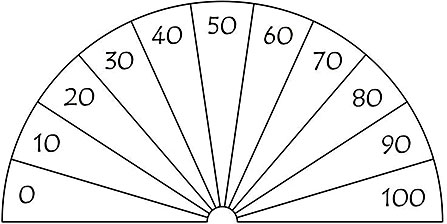
Before beginning, clearly state (either out loud or internally):
“This chart represents percentages from 0 to 100, where 0
means none and 100 means complete or full.”
This establishes a clear framework for the subconscious mind to
respond within.
1. Probability of Events
Controlled studies have shown that dowsers who ask the pendulum
yes/no questions about future events typically achieve an accuracy
rate of around 50%, which is no better than random
guessing. In my own experience, I can attest that asking the
pendulum to predict the future has often resulted in disappointment.
This is largely because the future is not fixed.
Human behavior is inherently unpredictable, and energetic conditions
shift constantly, altering plans, intentions, and outcomes.
Additionally, it has been suggested that the subconscious mind has
only a limited ability to perceive future events.
According to Max Freedom Long, in The Secret Science Behind
Miracles, the subconscious mind cannot glimpse the future on
its own. Instead, it must rely on a higher source to relay such
information to the conscious mind. He writes:
“The kahunas also believed that all premonition comes from
the High Self… the subconscious does not have the ability to look
into the future, but must have the future shown it by a being of
superior mental powers—the kahunas say by the Aumakua or High Self.”
I share the view that the subconscious mind is limited in its
ability to perceive future events. At best, it may be able to look
ahead a short distance—perhaps a day or two—based on existing
patterns and momentum. Only with the assistance of the Higher Self
can one perceive further ahead into what Max Freedom Long refers to as the
crystallized future. This, I believe, is the
mechanism by which many trained psychics are able to make accurate
predictions.
It follows, then, that the subconscious mind is most effective
not at predicting fixed outcomes, but at revealing
the current trajectory of energy and intention—where things are
presently headed and where energy is most likely to settle if no
changes are made. In this way, the pendulum becomes a tool for
assessing probability, not destiny.
Rather than asking the pendulum to declare future events as
absolute, consider asking:
·
“What is the probability, in percentage, that this
plan will succeed if I follow each step and remain consistent?”
·
“What is the likelihood that this opportunity will
benefit me if I choose to pursue it?”
·
“What percentage chance does this outcome have if
I continue as I am now?”
This approach allows you to assess probabilities without treating
the future as fixed or unchangeable.
2. Compatibility and Alignment
Percentages are also useful for measuring
resonance and
alignment between choices, paths, ideas, or routines.
Examples include:
·
“How effective is my current nutrition or fitness
routine for me?”
·
“What percentage of alignment do I have with this
plan or decision?”
·
“How compatible is this option with my highest
good, in percentage?”
This method is especially helpful when comparing multiple options
side by side.
3. Personal Energy Levels
You can also dowse for your current state of vitality, emotional
balance, or energetic clarity—especially before taking action or
beginning a practice.
Examples:
·
“What percentage is my physical energy right now?”
·
“What percentage is my emotional balance today?”
·
“What percentage of my energetic field is clear?”
This is also useful before dowsing sessions for others, healing
work, or important decisions.
4. Tracking Progress and
Effectiveness
Percentage dowsing is ideal for tracking improvement over time.
It can also be applied to physical goals such as weight management,
body composition, and overall balance.
Rather than focusing solely on the bathroom scale, you can ask questions
that reveal how and why changes are occurring:
·
“What percentage of my current weight is water
weight?”
·
“What percentage of fat loss has occurred since I
began this routine?”
·
“What percentage of my recent weight change is due
to water loss?"
By revisiting the same questions over days or weeks, you can
observe genuine trends instead of relying on isolated measurements.
You can also evaluate foods in terms of likelihood and
impact:
·
“What percentage likelihood does this food have of
contributing to weight gain for me?”
·
“What percentage likelihood does this food support
weight loss for my body?”
·
“How compatible is this food with my current
goals, in percentage?”
This personalized approach acknowledges that what benefits one
person may not benefit another.
6.
Scaling the Balance of Foods, Vitamins & Supplements in the Body
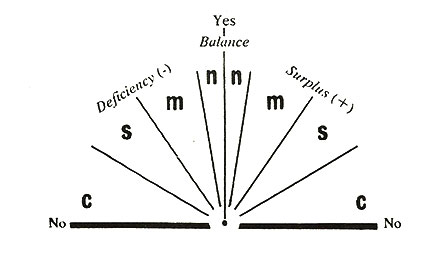
When experimenting with vitamins and minerals to
support health goals, balance is essential. While a
negative reading for a particular nutrient may suggest a need for
supplementation, excess can be just as detrimental as deficiency.
Moving too far toward either extreme can create new imbalances and
unintended issues. Maintaining equilibrium is especially important
in nutrition and supplementation.
Author and dowser Bill Finch developed the polarity chart
shown above to measure the negative and positive balance of various
minerals and nutrients. The letters N, M, S C on the chart stand
for:
N- Neutral or Normal
M- Mild
S - Severe
C - Critical
For example, if you wish to support your health by increasing
Vitamin C, the first step is to determine where your current Vitamin
C levels stand within the body.
Using the chart, begin by grounding and centering yourself. You
may hold a Vitamin C capsule in your left hand while suspending the
pendulum over the chart with your right hand. Then ask:
“On this chart of negative to positive polarity, where does
Vitamin C currently stand in my body?”
The pendulum will indicate whether there is a deficiency,
surplus, or balanced state. If the reading shows balance,
supplementation is unnecessary.
If a deficiency is indicated, dosage and period of time become
important factors to consider. You may then ask follow-up questions such as:
·
“If I consume one 500mg Vitamin C capsule daily,
for seven days, where will my Vitamin C levels register on this scale?"
·
“If I consume two 500 mg Vitamin C capsules—one during the day and
one at night for seven days—what will what will be the measurement
at that time?”
These questions help determine how much your body can accept
within a given timeframe
without disrupting its natural balance, allowing you to supplement
wisely rather than excessively.
Interpreting Results Wisely
Percentages and scaling polarity are snapshots of the
present moment. They reflect current conditions
energies—not unchangeable truths.
Keep in mind:
·
A 60% probability can often be increased through
action or awareness
·
A low energy percentage is information, not failure
·
Results naturally shift as you shift.
Approach percentage and polarity dowsing as a tool for
awareness—not prediction or control.
Final Thoughts
Gauging and measuring with the pendulum adds depth, flexibility,
and practicality to your dowsing practice. It moves you beyond
yes/no answers and into a more meaningful dialogue with your Inner
Wisdom.
With regular practice, percentage dowsing becomes a reliable way
to assess energy, probability, progress, and alignment—supporting
your personal efforts and helping you make clearer, more informed
choices.
|
